Black Label Movement

nav menu

Press

“An All-Weather Scene”

Dance Magazine

“Carl Flink’s Black Label Movement combines intense physicality with sophisticated structuring.”

Linda Shapiro, January 2012 Issue

Full Article

“Same Planet Different World’s Premiere of HIT

Chicago Tribune

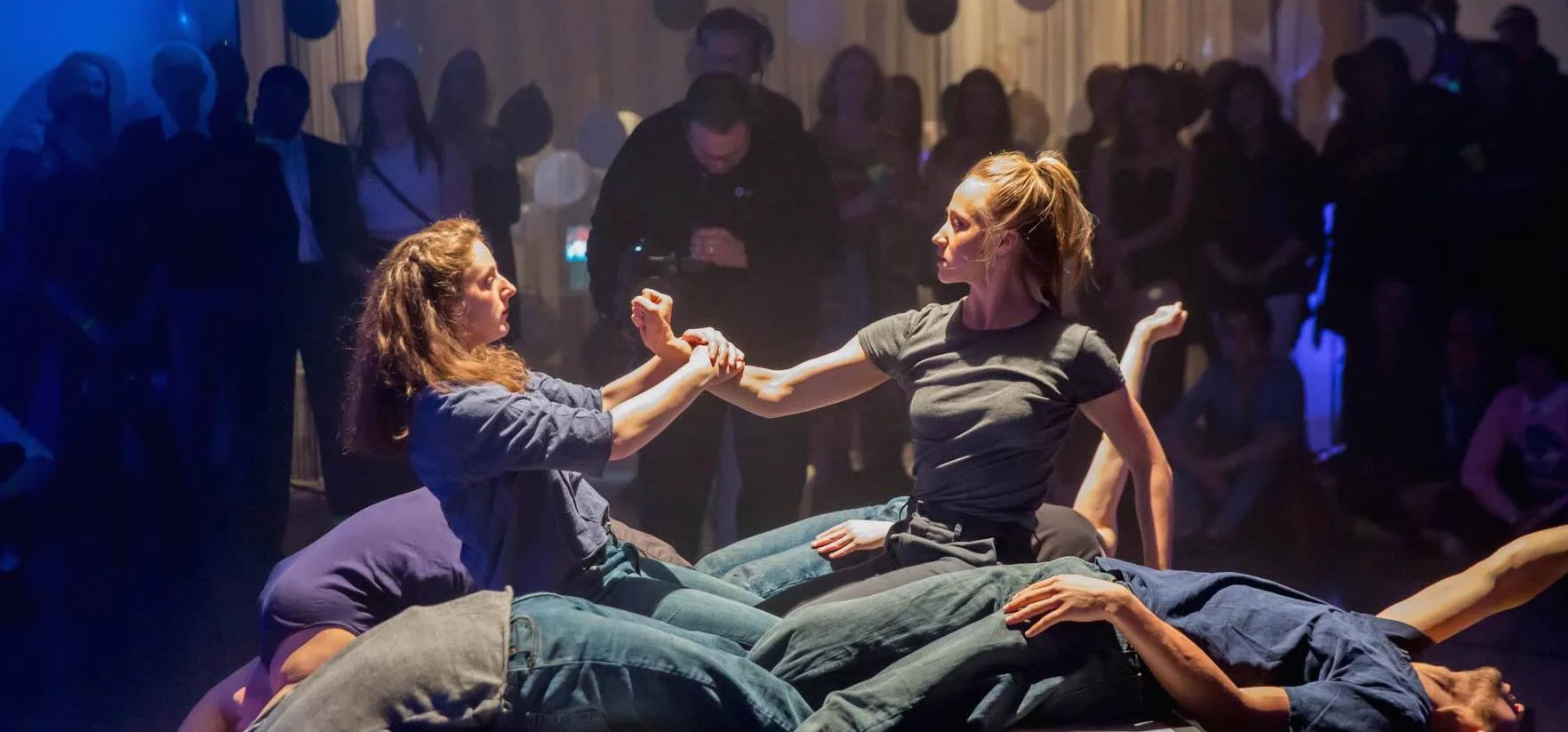
Flink “employs a singular, combative image, more an act of aggression, really, as signature motif. The dancers periodically punch each other, directly and often seemingly out of nowhere, as if in challenge or even mild assault. . . . The unexpected jabs to the shoulder and later the slaps initially seem almost cartoon-like.

But Flink’s aesthetic is more complicated, this combative edge intermingled with a wealth of feats of acrobatic oomph. Sparingly, he injects such images as a dancer leaping into the air and ending horizontal in the arms of others. In one arresting sequence, a dancer jumps over a huddled row of her colleagues as if they were barrels in a daredevil, split-second stunt.

The conflicting modes of aggression and partnership blend, in the end, into a work touching on adversity and endurance. A prone dancer balances one partner on his leg. Elsewhere, someone’s leg is bent to the point of torture — or is it a no-pain, no-gain effort of physical therapy? HIT meanders, a flow of movements without a clear organizing structure. But it also bonds audience and dancers, who struggle (with great success) to survive as much as entertain.”

Sid Smith, March 11, 2011

“The 2010 Minnesota Choreographer’s Evening”

The TC Daily Planet

For She: A Little Found Object is the title of the piece presented by Carl Flink and Black Label Movement. As the sole performer, Julie Brant McBride was enormously expressive in a flurry of angsty, abrupt movements lit dramatically by handheld spotlights in a scheme designed by Marcus Dilliard.”
-Jay Gabler, November 29, 2010

Full Article

“The Woyzeck Project”

Minneapolis/St. Paul Star Tribune

The Woyzeck Project named in Graydon Royce’s Top 5
“Seifert was involved in another of my favorite theater evenings this year. He and Carl Flink of Black Label Movement ripped up Georg Buchner’s story of an alienated soldier and reconstructed the parts into a jaw-dropping madhouse of vignettes and raging movement. Seifert and Flink used University of Minnesota students and dancers from BLM, and rarely have performers appeared so committed — especially when they are right up in your face.”

Full Article

Minneapolis/St. Paul Star Tribune

“Depictions of drownings and force feedings; blood-drenched mad men shrieking and stabbing away in a silo of white vinyl; dark club scenes borrowed from the decadent underbelly of German naturalism. The imagery may shock or amuse, but it consistently engages theatergoers at The Woyzeck Project. And we still haven’t gotten to the caged youngsters, clad in rags, screaming, dancing, climbing their chainlink fence, two feet in front of us.

Has The Woyzeck Project taken a conscious step back into Peter Brook’s 1960s theater of cruelty? Or does this vigorous and bizarre work represent aggressive new thinking on what constitutes theater? The answer might matter in retrospect, but it feels immaterial in the heat of this 50-minute exhibition created by Luverne Seifert and Carl Flink — with a little help from Michael Sommers.

The creators have turned the Southern into something of a house of horrors. We start on the sidewalk with a jolly Brechtian introduction to Woyzeck. Then it’s off to the back yard, fumed with grill exhaust from the adjoining restaurant — the perfect bouquet for what’s to come.

Moving inside, the bizarre cabaret of vignettes mentioned above fills every small space of the theater. You need not squint too hard to see Georg Buchner’s story of a lowly soldier who snaps under the pressure of militarism, medical experiments and eating too many green peas. Believing that his girlfriend, Marie, has slept with the drum major, he confronts the man, loses a humiliating wrestling match — which we see in the cage. Ushered back out to the cold, vacant lot for the finale, we watch as the character playing Buchner stabs Marie to death, surrounded by the mad young artists in their underwear,

The fragmentary and nonlinear approach explores Buchner’s tense psyche as he wrote the piece.

The performers — dancers from Black Label Movement and students from the University of Minnesota theater program — are a fully committed band up for nearly anything as they mingle with the audience in promenade style.

Stay away if you have qualms about exploding your pattern of taking a seat, dozing through the first act, rising for a soda at intermission and then running out the clock in the second act. If you want something different, come on in.” – Graydon Royce, October 25, 2010

Full Article

Minneapolis/St. Paul Magazine

“The Woyzeck Project” named in the Fall Arts Top Ten
Black Label Movement’s The Woyzeck Project
Local theater luminaries Michael Sommers and Luverne Seifert join choreographer Carl Flink’s Black Label Movement for an imaginative collaboration based on the play Woyzeck, a famously unfinished work by German playwright Georg Buchner. Oct. 19 – Nov. 6. The Southern Theater, southerntheater.org

Full Article

Reviews for BLM’s Third Southern Theater Season!

Minneapolis/St. Paul Star Tribune

“Dance tells stories of urban and rural life”

The Southern Theater stage is transformed into a pastoral landscape threatened by the concrete jungle for Black Label Movement’s “Field Songs.” Carl Flink’s physically demanding choreography unfolds on freshly laid sod, and the dancers, grass-stained and dirty by the work’s end, offer an alternately joyful and sobering glimpse into the ever-shifting boundaries between urban and rural ways of life. The thought-provoking piece is equal parts cultural commentary and political statement, punctuated by interludes of grace and violence.

“Field Songs” opens with Kaori Kenmotsu planting single blades of grass in a box surrounded by a gray environment. Behind her, eight company members step onto the sod, breathe deeply, pull on their work boots and commence movements that recall farm chores — threshing, planting, chopping — but soon their mundane gestures develop into something more idiosyncratic. Pent-up energy, not to mention despair and defiance, manifests itself through pounding fists and playful roughhousing, all fueled by memorable foot-stomping music played live by local roots-rockers the Jinnies.

Although parts of the piece are built around structured improvisations, the performers unite as a tightly knit group engaged in an unorthodox square dance. They initially embody the stoic personas of those who work the land, but they soon transcend stereotypes, and as the world around them becomes less certain they become wilder and more unpredictable in their relationships to one another. There’s much to ponder in this fascinating yet startlingly fragile emotional landscape cultivated by Flink in collaboration with his courageous dancers.

The program also includes works by company members Leslie O’Neill and Edward Bruno Oroyan. O’Neill’s “Trigger,” a 2009 solo for Emilie Plauché Flink, plays out as a gothic mystery. With her stuttering steps and gnarled hands, Flink is like an apparition, but later she’s a disturbed figure slithering around an abandoned swing set. This short work is long on intrigue and begs for a sequel. Oroyan’s 2000 effort “Golf Ball Hunting” is the dance Quentin Tarantino would want to make. The performers literally bounce off the walls, jump like ninjas, and go fast and furious from beginning to end. In short, it’s a blast.

Flink’s “Lost Lullabies” (2004) and a short version of 2006’s “A Fractured Narrative for a Sad Ending,” both well interpreted by the cohesive company, round out the evening.

- Caroline Palmer, June 1, 2009.

Link to Article

St. Paul Pioneer Press

Carl Flink creates dances that honor the lives and values of ordinary working people. There is a cleanness and clarity about the way his company of fearless movers sluice through space, as if they were clearing the air of arty pretension.

Flink calls his group Black Label Movement, a reference to generic food labels that defines his esthetic: no hype, no frills, no false packaging. But as Friday night’s concert at the Southern Theater vividly demonstrates, Flink also is a sophisticated artist who layers movement and meaning with a sure hand. Like the poet Walt Whitman, he sings the body electric.

His sod-busting, big-hearted dance “Field Songs” fills the Southern Theater with earthy aromas rising from a set of grass, dirt, concrete and corncobs by Annie Katsura Rollins and live music by the roots-rock band the Jinnies. A concrete triangle represents an urban environment where Flink muses and paces, conjuring up memories of a more idyllic rural space. The large swath of sod behind him becomes a wide-ranging field of dreams where nine dancers in work boots rip through a series of vignettes that range from robust roughhousing to spooky rituals. – Linda Shapiro, May 30, 2009.

Full Article

MNartists.org Preview

WHAT YOU GET WHEN YOU SEE BLACK LABEL MOVEMENT IS RISK. Breakneck take-offs, hurtling and sprawling bodies, the whump of impact with the floor or another dancer. And this isn’t just the carefully calibrated simulation of risk, either: these dancers are actively trying to leap higher than they can handle, to knock each other over, to get through. It’s a thrill to see such thrown momentum, but the thrill goes beyond the surface. You can’t see BLM without feeling sympathetic reverberations through your own body, without feeling your own crash and jump.

What you’re feeling, BLM Artistic Director Carl Flink hopes, is the revelation of mortality. “When I see immediate risk it is an opportunity to, in a very small microcosm, examine the arc of life. We know we’re at risk. At some point, it’s going to end.” And it’s typical of Flink’s rather existential viewpoint that he’s not afraid to speculate how — a heart attack, a fast bus, who knows? Before he began his dance career (which includes a stint at the prestigious Jose Limon Company in New York and, now, the chairmanship of the University of Minnesota’s Theater and Dance Department), Flink found his love of the ragged edge in years of serious soccer. In sports, “if you’re trying to master the moment, there’s almost always someone who will take a greater risk and surpass you. It’s not about mastery, it’s about how you keep pushing yourself so you can do something more extreme.” In the often rarefied, removed world of dance, Flink misses this intense apprehension of the now. – Lightsey Darst, May 26, 2009

Full Article

The TC Daily Planet

Most of the action takes place on the grass, the movers there presumably depicting the rural societies. While the rural dancers twist about in animalistic chaos, on the paved side of the stage a girl serenely tends to plants in a cordoned-off garden while Flink himself calmly lounges nearby. The result appears to equate the rural/urban split with a split between anarchy and order—a theme that doesn’t exactly portray rural societies in the most positive light. Regardless, the movers’ unpredictable motion and turbulent interactions make for an irresistible spectacle—even if at times you feel like you’re watching a funny farm. Local band the Jinnies provide a folksy bluegrass live accompaniment. – Jon Behm, June 1, 2009

Full Article

Past BLM Press

Dance Magazine

Flink “contrasts choral movement where the group becomes a single pulsating organism with solos and duets that reflect more personal turmoil.

Flink danced with the Limón Dance Company and apprenticed with Paul Taylor, so it’s no surprise that his movement recalls Limón’s heroic archetypes, Doris Humprey’s communal dynamics, and Taylor’s muscular exuberance. The powerful dancers, risk-takers all, deliver the combination of buoyant athleticism and feral intensity that is a hallmark of Flink’s style. They often move in tight formation—either within shifting groupings of wooden benches that define the compartment in which they are trapped, or careening through space, colliding and rebounding off of one another. Sometimes it’s like watching a display of cascading fireworks: carefully sculpted forms filled with volatile explosions of light.

Flink often confines dancers to a small area defined by the benches, compressing them like heroic working-class figures in a Diego Rivera mural. The benches become part of a fluid architecture where dancers grapple in stylized gestures of mutual support and desperate aggression. They summon up images of deck hands at work, storms at sea, a community in chaos—sometimes simultaneously.” – Linda Shapiro, February 2008.

Full Article

Minneapolis/St. Paul Star Tribune

“With Wreck, Carl Flink and his company, Black Label Movement, have created a riveting portrait of humanity on the brink, in which community is the bedrock of integrity.” – Camille LeFevre, January 14, 2008.

Full Article

“It’s extremely inventive choreography, infused with physical risk and kinetic surprise, riveting to watch. What makes Flink’s work compelling, however, is the caring intelligence that emanates from his movement vocabulary. These dances are human to the core. Watching them is exhilarating, emotional, moving.” – Camille LeFevre, Minneapolis/St. Paul StarTribune, August 20, 2006

“A profound emotional tenderness permeates the tough-minded physicality of Black Label Movement, which premiered its first full-length concert to a sold-out audience at the Southern Theater” -Camille LeFevre, Minneapolis/St. Paul StarTribune, August 20, 2006

“But then there are works so great that one wishes they’d never end. Only they do, at precisely the right moment, leaving you elated, shaken, breathless. They’ve been shaped, choreographed, phrased and performed with a rigor that allows for the ache of inevitability — but not before taking every muscle, tangle of emotions and welter of thoughts on a kinesthetic ride. Almost anything by Mark Morris falls into this category. So does Mathew Janczewski’s Resonance, Carl Flink’s Duet From Wreck, Uri Sands’ recent Veneers. If any of these works were a minute longer or shorter, would the experience be diminished? Hard to say. But it’s always better to leave the theater ecstatically wishing for more than having spent two hours counting every agonizing moment until you could escape. – Camille Lefevre, Minneapolis/St.Paul StarTribune, April 17, 2007.

From the StarTribune 2006 Year in Review, “This year Flink also premiered his new dance company, Black Label Movement. His inventive choreography, derived from physical risk and kinetic surprise, emanates a deep, soulful humanity.” – Camille Lefevre, Minneapolis/St.Paul StarTribune, December 26, 2006

In The Metropolitan Ballet’s premiere of it’s ballet Dracula, “Carl Flink’s visceral scene, with dancers from his Black Label Movement, was one you could really sink your teeth into. Once again, Oroyan tore weightlessly through space, extracting every drop of character from his role as if the weight of the entire show rested on his shoulders.” – Camille Lefevre, Minneapolis/St.Paul StarTribune, October 31, 2006.

St. Paul Pioneer Press

“Watching Carl Flink’s dynamic Black label Movement dancers forge their way through his magnum force pieces, you can’t help wonder why dance has not been designated as an Olympic sport. But then again, what sport could match the blend of gymnastic control and nonstop momentum of Flink’s choreography? Or its beautifully sculpted movement? Or it’s emotional wallop?” -Linda Shapiro, St. Paul Pioneer Press, August 20, 2006.

“Flink and Plauché Flink’s choreography oozes elegance, intelligence and the irrepressible vigor of artists approaching the top of their game.” -Linda Shapiro, St. Paul Pioneer Press, August 20, 2006.

“Meanwhile, Flink carefully designs the space — sometimes by personally shining a searchlight on particular dancers — imposing visual texture and sculptural clarity on their frenetic movement.” -Linda Shapiro, St. Paul Pioneer Press, August 20, 2006.

In The Metropolitan Ballet’s premiere of it’s ballet Dracula, a scene “choreographed by Carl Flink and danced with frenzied fluidity and gymnastic prowess by Oroyan and members of Flink’s Black Label Movement company, the scene sizzles with pity and terror.” Linda Shapiro, St. Paul Pioneer Press, October 29, 2006.

Howwastheshow.com

Throughout Wreck the BLM movers “move about the stage in seemingly chaotic and random ways. However, their perfect interaction and seamless movements suggest that there is some defining force at work. The force, of course, is the choreography of Carl Flink, the wunderkind behind Wreck as well as a BLM performer. His piece loosely details a stormy boat journey across the Great Lakes. While the story is nearly impossible to follow in a linear fashion, I don’t believe that it is meant to be translated literally into something easily understood. Rather, it is a collection of dreamlike sequences—some eerily cheerful, many downright nightmarish, that are all tied together with invisible strands to the idea of crossing a body of water.” Jon Behm, January 11, 2008.
Full Article

MPR News

Carl Flink gives dance a sporting chance

A new Minnesota dance company called Black Label Movement is the creation of the new director of the University of Minnesota’s Dance Program. Carl Flink has managed to cross from the world of sports to dance, and he’d like to have some other athletes join him.

Minneapolis native Carl Flink is a seasoned dancer. He danced in New York City for ten years with, among others, the nationally known Jose Limon Company. But he’s the first person to admit he’s never looked the part.

“I just did not and do not have a traditional dancer’s body,” laughs Flink. “Indeed when I was with the Limon company, even after being a senior dancer and soloist, I was the dancer most likely to be mistaken for a stagehand.”

Flink looks more like a linebacker than professional dancer. His Black Label Movement Company is a no-nonsense modern dance group with moves heavily influenced by Flink’s many years playing soccer. In the dance “Lost Lullabies” the sounds of dancers gasping for breath and stomping the floor become as much a part of the soundtrack as the music.

Flink says he still loves to play soccer, but he chose dance over sports because he wasn’t interested in all the competition.

“The best dance photos I’ve ever seen in some ways are on sports pages,” says Flink. “Three guys diving for a football and they’re all horizontal to the floor. That’s what I want in my dances, except I want to take the ball out of the image. I want to have three dancers flying, not because they’re trying to score or stop someone from scoring but purely for the joy of diving and being horizontal to the floor.”
-Marianne Combs, August 17, 2006

Full Article